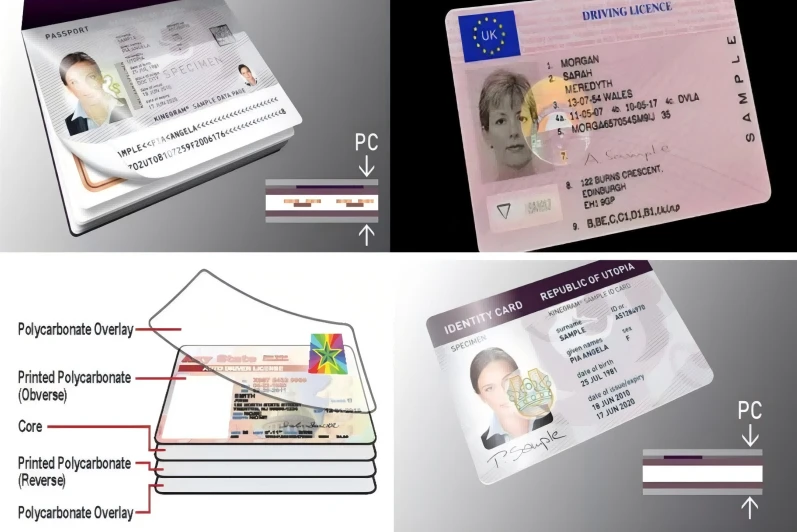
Most ID cards are made of plastic, with PVC, PETG, and PC,which are the most prevalent. Some nations and areas also utilize anti-counterfeiting paper or Teslin synthetic material, together with lamination pouches, for national ID cards, driver's licenses, and other credentials.
Over time, the industry has moved from PVC to PETG and, more recently, to PC. Because of its superior properties, PC has grown in popularity for ID documents, particularly in Europe and North America.
Below, we compare different materials in terms of security aspect.
PVC: PVC lacks intrinsic security measures, relying instead on extra printing and encryption techniques for protection. Security features are often added using special inks, optical security laminates, or overlays.
PETG, like PVC, does not have inherent strong security characteristics. However, it can have extra security features such as register optical anti-counterfeiting, fluorescent ink printing, and so on. Because of its smooth surface, it may outperform PVC in certain anti-counterfeiting treatments.
PC: Special production techniques and anti-counterfeiting features, such as the addition of security fibers, surface laser etching, laser personalizing, ghost pictures, and so on, can improve anti-counterfeiting performance in PC materials. These anti-counterfeiting features are intimately integrated with PC materials, providing a reasonably high level of protection.